
What Do Your Words Say About Your Heart?

On a recent weekend, my son came home from college to attend an event.
I loved having him home. But as the weekend went on, I started noticing something. So much of what came out of his mouth was negative.
“I hate this.”
“That person is stupid.”
“That person is an idiot.”
It seemed like one negative comment after another.
This isn’t completely new for him. Underneath his sharp tongue, he has a kind heart and will fiercely defend his friends and those he cares about. But he has a tendency to be quick with critical comments, even though my husband and I usually try to see the best in people and give people the benefit of the doubt.
But this weekend, I noticed his negativity more than usual. And honestly, it was hard to listen to.
My husband and I eventually mentioned it to him. I’ve also noticed that a few of the people he has been hanging out with recently can be pretty negative when they talk about other people, and I wondered if maybe they were unintentionally reinforcing that habit in each other.
The morning after he went back to college, I was doing my Bible reading when I came across a verse that made me think about our conversation.
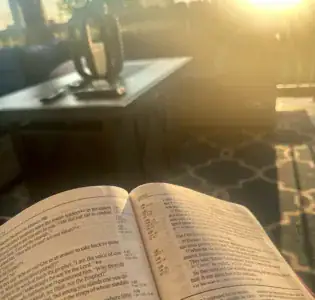
In Luke 6:45 (NIV), Jesus says:
“For the mouth speaks what the heart is full of.”
I highlighted the verse and sent it to my son.
I told him that this was part of the reason it was hard for me to hear so much negativity coming from him. If the words are an overflow of the heart, then hearing bitterness, anger or criticism over and over again is worth paying attention to.
My son considers himself a Christian, so I knew I could talk to him about this from that perspective. I realize that someone who doesn’t believe in the Bible isn’t necessarily interested in using it as a guide for how they live their life. But for those of us who do consider ourselves followers of Jesus, verses like this give us an opportunity to stop and reflect on how we are living our lives.
And that’s where this became about more than my son.
Because it’s really easy to find a Bible verse and think, Oh, so-and-so needs to hear this. It’s a little harder to ask:
What does this say about me?
When Our Words Reveal What’s in Our Hearts
When I sent that verse to my son, I told him I thought there were two possibilities.
Maybe all of the negativity coming out of his mouth really was an overflow of something going on in his heart.
Was he angry? Bitter? Frustrated?
Was there something bothering him that he hadn’t really dealt with?
Or maybe it wasn’t that deep at all. Maybe being negative had simply become a habit.
His response was actually pretty simple. He told me he hadn’t realized he was being so negative and now that he was aware of it, he was going to work on it. He even said he might talk to his friends about it.
And I think there’s something important in that response.
Sometimes we simply don’t hear ourselves.
We don’t notice how often we complain. We don’t realize how quickly we point out what’s wrong with someone. We don’t hear how frequently we say we hate something, criticize someone or assume the worst. It can become such a normal way of talking that we don’t even realize we’re doing it.
But sometimes our words are telling us something.
When Negative Words Are a Sign of Something Deeper
The Bible has a lot to say about our words, but I think the idea that our words can reveal what’s happening in our hearts is especially powerful.
Proverbs 4:23 (NIV) says:
“Above all else, guard your heart, for everything you do flows from it.”
If I notice that I’ve become unusually negative, maybe the answer isn’t simply to tell myself, Kristi, stop complaining.
Maybe I need to ask why I’m complaining so much in the first place.
Is there someone I need to forgive? Am I holding onto resentment? Am I stressed or overwhelmed? Am I exhausted and taking that exhaustion out on other people? Sometimes yes! Especially to those last couple.
Am I spending so much time around negativity that I’ve started absorbing it myself? Is there something going on in my life that I need to bring to God instead of carrying it on my own?
Those aren’t questions we need to ask ourselves with shame or judgment.
They’re just a heart check.
Sometimes the words coming out of our mouths can be like a check engine light, letting us know something inside needs our attention. And if that’s the case, simply trying to stop saying negative things probably isn’t going to get us very far.
We need to look at what’s lying beneath the words.
Sometimes Negativity Is Just a Habit
But I don’t think every negative comment means we have some terrible bitterness hiding deep inside us. Not at all.
Sometimes a bad habit is just a bad habit.
Maybe complaining has become our default conversation, or sarcasm and bad language come out before we even think about it. We might have gotten so used to pointing out what’s wrong that we rarely stop to notice what’s right.
And if we’re surrounded by people who talk that way, it’s easy to fall into the same pattern without even realizing it.
That still matters.
Ephesians 4:29 (NIV) gives us a pretty good standard to think about:
“Do not let any unwholesome talk come out of your mouths, but only what is helpful for building others up…”
I think the phrase building others up is worth paying attention to.
Because this isn’t about pretending everything is wonderful all the time. Trust me, this is a heart check for me just as much as anyone else, and my language can certainly use some cleaning up.
There is a time to disagree. There is a time to point out a problem. There is a time to have a difficult conversation. And there is certainly a time to tell the truth in love.
Being a positive person doesn’t mean ignoring reality or pretending people never make mistakes.
But there is a big difference between being honest and constantly looking for something—or someone—to criticize.
Think About the People You Love Being Around
Think for a minute about the people you genuinely enjoy spending time with.
How do you feel when you leave them?
I’m guessing at least some of the people you feel best around are people who make you feel seen.
Maybe they give genuine compliments. They may call out your strengths. They might thank you for something you did or tell you they’re happy to see you. Maybe they’re simply the kind of person who makes you feel a little better after you’ve spent time with them.
They aren’t necessarily positive every second of every day. They have problems. They get frustrated. They have bad days just like everyone else.
But being around them doesn’t leave you feeling constantly drained.
That’s something I’ve talked about with my kids over the years.
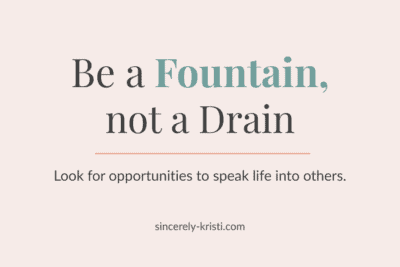
Do you want to be a fountain or a drain?
Some people seem to drain the energy out of the room. Constant complaining, criticism and negativity can do that.
Other people seem to add something. They encourage, notice, and appreciate the people around them. They speak life into others and somehow leave people feeling a little lighter.
That’s what I’ve started thinking of as fountain energy.
And I want to bring more of that into the world.
What If We Looked for Opportunities to Speak Life?
Here’s something else I’ve noticed.
When I make someone else feel good, I usually feel better too.
If I stop and give someone a genuine compliment, thank someone for something they did or tell someone I appreciate them, that interaction doesn’t only affect them. It also affects me.
For that moment, instead of looking for what’s wrong, I’m intentionally looking for what’s good. And maybe that’s one way we begin changing a habit of negativity.
Instead of spending all our energy trying not to say negative things, what if we started intentionally looking for positive things worth saying?
Not fake things. Not flattery. Not pretending everything is great.
Just genuine, good things we might normally think but never actually say out loud.
You did a really good job with that.
Thank you for always doing that. I know I don’t say it enough.
I really enjoy spending time with you.
You handled that situation really well.
I appreciate you.
How many of those thoughts pass through our minds without ever making it out of our mouths? What would happen if we started saying them?
Try One “Fountain Moment” a Day
So here’s a little challenge I’m giving myself, too.
For the next week, look for one fountain moment each day. One opportunity to put something good into someone else’s day.
Thank someone who probably doesn’t get thanked enough. Give the compliment you were thinking anyway. Tell your spouse something you appreciate about them.
Point out something your child did well instead of only noticing what they forgot to do. Send a friend the text. Tell a coworker you appreciate their help.
It doesn’t need to be anything big. Just notice the opportunity—and take it.
And while you’re doing that, pay attention to the other words coming out of your mouth, too.
Not so you can keep score. Not so you can feel guilty every time you complain.
Just notice.
A Gentle Heart Check for All of Us
Maybe that’s the real takeaway from all of this.
Every once in a while, listen to yourself.
What have you been saying about your spouse? Your children? Your coworkers? Your friends?
How about the stranger who annoyed you at the store? The person driving in front of you? The people you see online?
And maybe one of the most important questions:
What have you been saying about yourself?
Then ask:
Are the words coming out of my mouth a reflection of what’s in my heart?
Whatever the answer, I think it’s worth paying attention.
Maybe there’s something in our hearts that needs a little attention. Or maybe we’ve simply fallen into some habits that aren’t doing us, or anyone around us, much good.
Either way, awareness is a pretty good place to start.
That’s what happened with my son.
He didn’t realize how negative he sounded until someone who loved him pointed it out. And then, while I was pointing it out to him, God’s Word turned the question right back around on me.
Because Luke 6:45 isn’t only a Bible verse about negative words that I can send to someone else when I think they need it.
It’s for me, too.
So this week, I’m going to pay a little more attention to the words coming out of my own mouth.
And when I have the choice, I’m going to look for opportunities to bring a little more fountain energy.
Maybe you’ll join me.
Sincerely,
Kristi
Want to spend more time reflecting and connecting with God? My free Prayer Starter Kit offers a simple, approachable way to get started, even if you’re not sure what to say.


